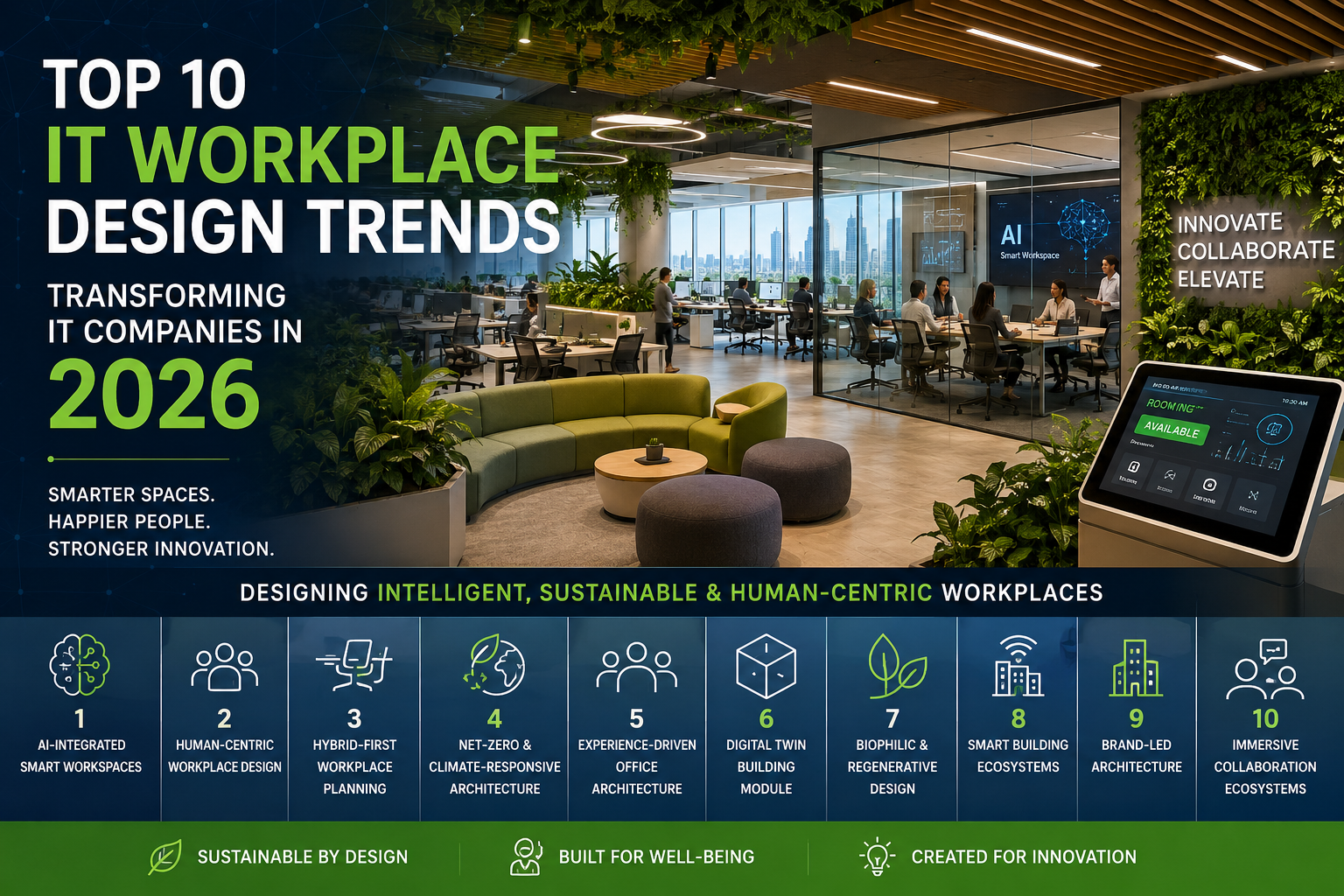
Designing Immersive Collaborative Spaces 2026
The Future of Collaborative Workspace Design
As technology continues to reshape how organizations operate, modern workplaces are evolving beyond traditional office layouts. Leading IT companies are increasingly investing in immersive collaborative workspace design to foster innovation, improve employee engagement, and accelerate decision-making. Today’s most successful workplaces are no longer defined by rows of desks and enclosed meeting rooms. Instead, they function as dynamic innovation ecosystems where architecture, technology, and human creativity seamlessly converge. Through strategic IT office design and workplace architecture, organizations can create future-ready workspaces that encourage collaboration, productivity, and business growth. An immersive collaborative space is intentionally designed as a high-energy innovation environment rather than simply a larger conference room. The objective is to accelerate ideation, enhance visualization, improve decision-making, and facilitate cross-disciplinary interaction.
1. Create Multiple Modes of Collaboration
Modern collaborative workspace design should include a sequence of interconnected environments rather than a single meeting room. Different tasks require different settings, and successful workplace architecture accommodates diverse work styles. Recommended collaboration zones include:
Focus Pods (2–4 people)
Team Studios (8–12 people) Innovation Labs (20–30 people)
Townhall Collaboration Spaces
Informal Café Discussion Areas
Research shows that many breakthrough ideas emerge in transitional spaces between formal work environments. By designing a variety of collaborative zones, organizations can encourage spontaneous interaction and knowledge sharing.
2. Design for Digital Immersion
Technology is a critical component of modern IT office design. Collaborative spaces should support digital interaction and real-time information sharing. Key features include:
Floor-to-ceiling digital walls
Interactive touch displays
Real-time project dashboards
AI-assisted brainstorming systems
Mixed Reality (AR/VR) visualization zones
For software companies and technology organizations, digital immersion enables teams to visualize data, workflows, code architecture, product roadmaps, and user journeys at room scale, significantly improving communication and decision-making.
3. Use Architecture to Encourage Interaction
The physical environment plays a significant role in how people collaborate. Traditional rectangular boardrooms often create barriers to engagement and communication.
Alternative workplace design solutions include:
Curved collaboration spaces
Amphitheater-style seating
Circular discussion hubs
Tiered platforms
Open stair collaboration zones
These architectural elements naturally foster interaction, encourage participation, and reduce hierarchical barriers within teams.
4. Build Dedicated Project War Rooms
Innovation thrives when teams have spaces dedicated to ongoing collaboration and project development.
A successful project war room should include:
|Writable walls
Pin-up surfaces
Flexible furniture systems
Multiple display screens
Acoustic separation
These environments allow project teams to leave work visible, continuously refine ideas, and maintain momentum over extended periods.
5. Integrate Biophilic Elements
Biophilic design has become one of the most influential office design trends in recent years. Studies consistently demonstrate that natural materials, daylight, greenery, and outdoor views improve creativity, cognitive performance, and employee well-being.
Incorporating biophilic design into collaborative workspaces can include:
Indoor plants and green walls
Natural lighting strategies
Organic materials and textures
Visual connections to nature
Outdoor collaboration terraces
For modern IT offices, biophilic elements help create healthier, more engaging workplace environments.
6. Prioritize Acoustic Performance
Many collaborative spaces fail because noise levels interfere with concentration and communication. Effective workplace design must balance collaboration with focused work.
Essential acoustic solutions include:
Acoustic ceiling systems
Fabric wall panels
Sound-absorbing flooring
Enclosed focus rooms
Speech privacy zones
Proper acoustic planning ensures that collaboration can occur without negatively impacting productivity.
7. Create Hybrid-First Collaboration Spaces
Hybrid work has fundamentally changed workplace requirements. Every meeting room and collaborative environment should support both physical and remote participants equally.
Hybrid-ready workspaces should consider:
Strategic camera placement
High-quality lighting
Clear display visibility
Advanced microphone coverage
AI-powered meeting support
Organizations that prioritize hybrid workplace design can create seamless experiences for distributed teams while maintaining productivity and engagement.
8. Introduce an Immersive Experience Layer
Forward-thinking IT companies are creating immersive workplace experiences that enhance innovation and employee engagement.
Examples include:
Interactive media walls
Data visualization tunnels
AI-powered wayfinding systems
Responsive lighting environments
Digital twin command centers
These technologies transform traditional offices into intelligent innovation spaces where information, collaboration, and creativity coexist.
Designing a Future-Ready IT Collaboration Hub
One highly effective workplace architecture model is:
Innovation Plaza → Collaboration Studios → VR/XR Lab → Project War Rooms → Focus Pods → Social Café
This layout reflects how innovation naturally occurs within technology organizations, supporting both spontaneous interaction and deep problem-solving. By creating a journey through different collaborative environments, organizations can support every stage of the innovation process, from ideation and prototyping to execution and implementation .
The Architectural Takeaway
The future of workplace architecture lies in designing spaces that facilitate knowledge exchange, rapid prototyping, hybrid collaboration, and continuous innovation.
The most successful IT workplaces are becoming less like traditional offices and more like innovation campuses where physical space, digital technology, and human creativity operate as one integrated system.
Organizations that invest in collaborative workspace design today will be better positioned to attract talent, improve employee experience, and drive long-term business success.
At Space Studio Chennai, we specialize in designing high-performance workplaces, commercial environments, and future-ready IT offices across India and internationally. Our design philosophy combines innovation, sustainability, technology integration, and human-centric architecture to create workspaces that inspire productivity, collaboration, and growth.
Connect with Space Studio Chennai to discover how intelligent workplace design can transform your business environment into a powerful driver of success.
Contact Space Studio Chennai
📍 Address: 11, Sterling Rd, Nungambakkam, Chennai, Tamil Nadu 600034
📞 Phone: 99620 11113
📧 Email: info@spacestudiochennai.com
🌐 Website: spacestudiochennai.com

Space Studio Chennai
Ar. Shashi is consumed by Curved Architecture. With over two decades of excellence in architecture, she is the Chief Architect at Space Studio Chennai (SSC), a leading design studio that specialises in Avant-Garde office spaces. She also owns ASSH- High-End Signature Family Homes brand and her other Firm, Shrithi, specialises in Free-Form Eco Resorts. Her mission is to create aesthetically appealing and functional spaces that are carbon-neutral and sustainable, without compromising on the client’s needs, vision, and dreams.